


Page 887 - Rollingbearings
P. 887
Design considerations
           Design                            Raceways on shafts

           considerations                    and in housings

                                             • should have the same hardness, surface
           Abutment                            inish and axial run-out as a bearing

           dimensions                          washer, if the load carrying capacity of a
                                               cylindrical roller and cage thrust assembly
                                               is to be fully exploited
           Abutment dimensions should fulil the   • should be designed using the dimensions
           following:                          E  and E  (product table, page 888),
                                                a
                                                     b
                                               which take radial displacement of the
           • Support surfaces in housings and on   roller set into consideration
            shafts should be at right angles to the
            shaft axis and provide uninterrupted   For additional information, refer to Raceways
              support over the entire washer face.  on shafts and in housings, page 179.
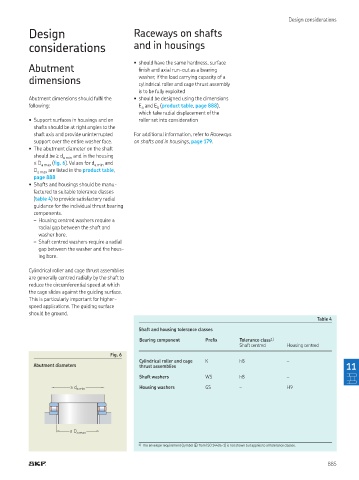
           • The abutment diameter on the shaft
            should be ≥ d a min  and in the housing
            ≤ D a max  (ig. 6). Values for d a min  and
            D a max  are listed in the product table,
            page 888
           • Shafts and housings should be manu-
            factured to suitable tolerance classes
            (table 4) to provide satisfactory radial
            guidance for the individual thrust bearing
            components.
               – Housing centred washers require a
              radial gap between the shaft and
              washer bore.
               – Shaft centred washers require a radial
              gap between the washer and the hous-
              ing bore.

           Cylindrical roller and cage thrust assemblies
           are generally centred radially by the shaft to
           reduce the circumferential speed at which
           the cage slides against the guiding surface.
           This is particularly important for  higher-
           speed applications. The guiding surface
           should be ground.
                                                                                                          Table 4
                                               Shaft and housing tolerance classes
                                               Bearing component     Preix      Tolerance class 1)
                                                                                Shaft centred   Housing centred
                                      Fig. 6
                                               Cylindrical roller and cage   K  h8              –
            Abutment diameters                 thrust assemblies                                                    11
                                               Shaft washers         WS         h8              –

                                               Housing washers       GS         –               H9
                        ≥ d a min


                        ≤ D a max

                                               1)   The envelope requirement (symbol � from ISO 14405-1) is not shown but applies to all tolerance classes.

                                                                                                              885

