


Page 781 - Rollingbearings
P. 781
Designs and variants
Acceleration System solutions for vibrating
screens
Vibratory applications induce accelerations
of the rollers and cages in the bearings This
puts extra demands on the bearing design In addition to single bearings for vibrating
SKF spherical roller bearings for vibratory screens, SKF has developed fault detection
applications can withstand considerably and bearing arrangements that can improve
higher accelerations than corresponding performance, reduce maintenance and
standard bearings The permissible acceler- monitor machine condition in vibratory
ation depends on the lubricant and the mode equipment
of acceleration
• Mode 1
The bearing is subjected to a rotating
outer ring load in combination with a
rotating acceleration ield, or an internally
induced angular acceleration ield caused
by rapid speed variations These acceler-
ations cause the unloaded rollers to gen-
erate cyclic loads on the cages Examples:
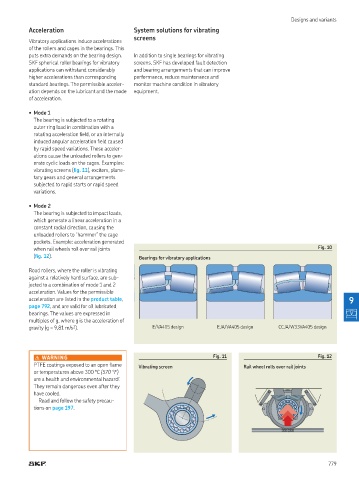
vibrating screens (ig. 11), exciters, plane-
tary gears and general arrangements
subjected to rapid starts or rapid speed
variations
• Mode 2
The bearing is subjected to impact loads,
which generate a linear acceleration in a
constant radial direction, causing the
unloaded rollers to “hammer” the cage
pockets Example: acceleration generated
when rail wheels roll over rail joints Fig. 10
(ig. 12) Bearings for vibratory applications
Road rollers, where the roller is vibrating
against a relatively hard surface, are sub-
jected to a combination of mode 1 and 2
acceleration Values for the permissible
acceleration are listed in the product table, 9
page 792, and are valid for oil lubricated
bearings The values are expressed in
multiples of g, where g is the acceleration of
gravity (g = 9,81 m/s 2 ) E/VA405 design EJA/VA405 design CCJA/W33VA405 design
WARNING Fig. 11 Fig. 12
PTFE coatings exposed to an open lame Vibrating screen Rail wheel rolls over rail joints
or temperatures above 300 °C (570 °F)
are a health and environmental hazard!
They remain dangerous even after they
have cooled
Read and follow the safety precau-
tions on page 197
779

