


Page 777 - Rollingbearings
P. 777
Designs and variants
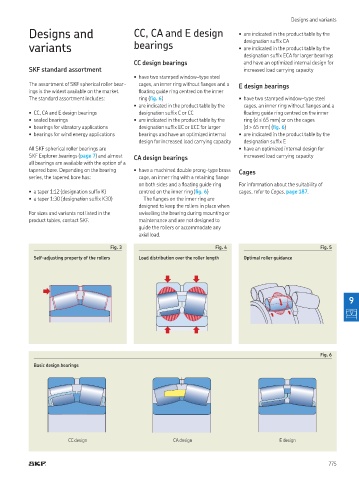
           Designs and                       CC, CA and E design                • are indicated in the product table by the
                                                                                  designation sufix CA
           variants                          bearings                           • are indicated in the product table by the
                                                                                  designation sufix ECA for larger bearings
                                             CC design bearings                   and have an optimized internal design for
           SKF standard assortment                                                increased load carrying capacity
                                             • have two stamped window-type steel
           The assortment of SKF spherical roller bear-  cages, an inner ring without langes and a   E design bearings
           ings is the widest available on the market    loating guide ring centred on the inner
           The standard assortment includes:   ring (ig. 6)                     • have two stamped window-type steel
                                             • are indicated in the product table by the   cages, an inner ring without langes and a
           • CC, CA and E design bearings      designation sufix C or CC          loating guide ring centred on the inner
           • sealed bearings                 • are indicated in the product table by the   ring (d ≤ 65 mm) or on the cages
           • bearings for vibratory applications  designation sufix EC or ECC for larger   (d > 65 mm) (ig. 6)
           • bearings for wind energy applications  bearings and have an optimized internal   • are indicated in the product table by the
                                               design for increased load carrying capacity  designation sufix E
           All SKF spherical roller bearings are                                • have an optimized internal design for
           SKF Explorer bearings (page 7) and almost   CA design bearings         increased load carrying capacity
           all bearings are available with the option of a
           tapered bore  Depending on the bearing   • have a machined double prong-type brass   Cages
           series, the tapered bore has:       cage, an inner ring with a retaining lange
                                               on both sides and a loating guide ring   For information about the suitability of
           • a taper 1:12 (designation sufix K)  centred on the inner ring (ig. 6)  cages, refer to Cages, page 187.
           • a taper 1:30 (designation sufix K30)  The langes on the inner ring are
                                               designed to keep the rollers in place when
           For sizes and variants not listed in the   swivelling the bearing during mounting or
             product tables, contact SKF.      maintenance and are not designed to
                                               guide the rollers or accommodate any
                                               axial load.

                                      Fig. 3                            Fig. 4                             Fig. 5
            Self-adjusting property of the rollers  Load distribution over the roller length  Optimal roller guidance


                                                                                                                     9


                                                                                                           Fig. 6
            Basic design bearings


                        CC design                         CA design                           E design


                                                                                                              775

