


Page 674 - Rollingbearings
P. 674
8 Tapered roller bearings
TDI design bearings Table 1
TDO design variants and characteristics
• have two outer rings (cups) and one
double row inner ring with two roller and Design variant Characteristics
cage assemblies (double cone), usually
with an intermediate ring between the two
outer rings (ig. 14, page 671) TDO • intermediate ring between two inner rings
• steel window-type cages
• have rows of rollers arranged face-to-face
(load lines converge toward the bearing
axis)
• are available open or capped with shields
or seals TDO.1 • intermediate ring between two inner rings
• steel pin-type cages (pierced rollers) for higher
– HNBR or FKM contact seal on both sides loads
• are ready-to-mount units, manufactured
with the predetermined axial clearance or
preload
• are designed primarily for use as locating TDON • without intermediate ring
bearings • inner rings abut each other
• steel window-type cages
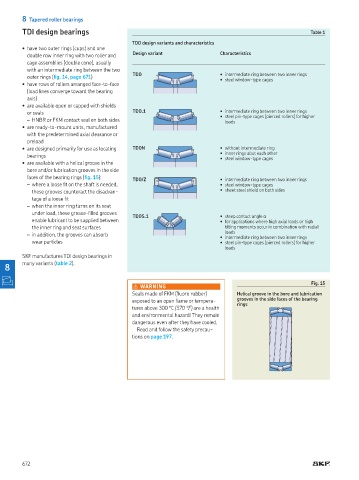
• are available with a helical groove in the
bore and/or lubrication grooves in the side
faces of the bearing rings (ig. 15):
TDO/Z • intermediate ring between two inner rings
– where a loose it on the shaft is needed, • steel window-type cages
these grooves counteract the disadvan- • sheet steel shield on both sides
tage of a loose it
– when the inner ring turns on its seat
under load, these grease-illed grooves TDOS.1 • steep contact angle α
enable lubricant to be supplied between • for applications where high axial loads or high
the inner ring and seat surfaces tilting moments occur in combination with radial
loads
– in addition, the grooves can absorb
• intermediate ring between two inner rings
wear particles • steel pin-type cages (pierced rollers) for higher
loads
SKF manufactures TDI design bearings in
8 many variants (table 2)
Fig. 15
WARNING
Seals made of FKM (luoro rubber) Helical groove in the bore and lubrication
exposed to an open lame or tempera- grooves in the side faces of the bearing
rings
tures above 300 °C (570 °F) are a health
and environmental hazard! They remain
dangerous even after they have cooled.
Read and follow the safety precau-
tions on page 197.
672

