


Page 1096 - Rollingbearings
P. 1096
25  Lock nuts
        HM and HME metric lock                                                                           Fig. 8
        nuts                                                                    HME lock nut, with recessed side face

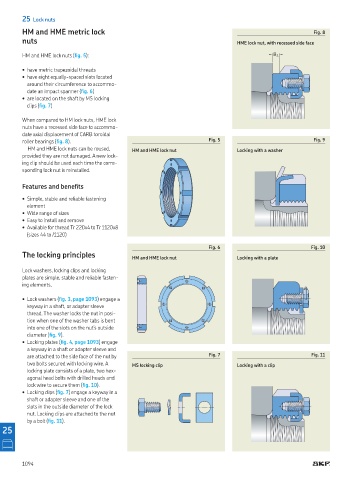
        HM and HME lock nuts (ig. 5):                                                       B 3

        • have metric trapezoidal threads
        • have eight equally-spaced slots located
          around their circumference to accommo-
          date an impact spanner (ig. 6)
        • are located on the shaft by MS locking
          clips (ig. 7)

        When compared to HM lock nuts, HME lock
        nuts have a recessed side face to accommo-
        date axial displacement of CARB toroidal
        roller bearings (ig. 8)                                       Fig. 5                             Fig. 9
          HM and HME lock nuts can be reused,   HM and HME lock nut             Locking with a washer
        provided they are not damaged  A new lock-
        ing clip should be used each time the corre-
        sponding lock nut is reinstalled

        Features and beneits
        • Simple, stable and reliable fastening
          element
        • Wide range of sizes
        • Easy to install and remove
        • Available for thread Tr 220x4 to Tr 1120x8
          (sizes 44 to /1120)

                                                                      Fig. 6                            Fig. 10
        The locking principles               HM and HME lock nut                Locking with a plate

        Lock washers, locking clips and locking
        plates are simple, stable and reliable fasten-
        ing elements

        • Lock washers (ig. 3, page 1093) engage a
          keyway in a shaft, or adapter sleeve
          thread  The washer locks the nut in posi-
          tion when one of the washer tabs is bent
          into one of the slots on the nut’s outside
          diameter (ig. 9)
        • Locking plates (ig. 4, page 1093) engage
          a keyway in a shaft or adapter sleeve and
          are attached to the side face of the nut by                 Fig. 7                            Fig. 11
          two bolts secured with locking wire  A   MS locking clip              Locking with a clip
          locking plate consists of a plate, two hex-
          agonal head bolts with drilled heads and
          lock wire to secure them (ig. 10)
        • Locking clips (ig. 7) engage a keyway in a
          shaft or adapter sleeve and one of the
          slots in the outside diameter of the lock
          nut  Locking clips are attached to the nut
          by a bolt (ig. 11)
  25


        1094

