


Page 1008 - Rollingbearings
P. 1008
18  High temperature bearings


          More informatione information    SKF high temperature bearings are designed   when they cool rapidly, and therefore
          Mor
                                           to deliver increased reliability, reduced com-    provide a long service life
                                           plexity and decreased environmental impact
          Bearing life and load ratings      al bearing knowledge
                                     17
          Gener                      63    in operating temperatures up to 350 °C   • Excellent performance under severe
                                           (660 °F)  Because SKF high temperature   conditions:
          Design considerations                earing selection process
                                     59
  18      B                          59    bearings correspond to the ISO dimensions     – hot conditions
                                    1609
          B                         13     of grease-lubricated bearings, production     – dry environments
          Bearing systems                            earing interfaces
          Se
          Recommended its                        at tolerances for standard   169  eficiencies and cost savings can be realized     – low rotational speeds
          c Abutment and illet dimensions    onditions                                        2088  with a simple change to the SKF bearing
                                    14
          Sealing, mounting and            solution                           • Reduced environmental impact
                                    193
          dismounting
          Lubrication                                      239  The environmental beneits of SKF high
                                           temperature bearings are so signiicant in   • Reduced machine design complexity
          Mounting instructions for        many applications that they are included in
          Mounting, dismounting and
                                    271
          individual bearings  † skf com/
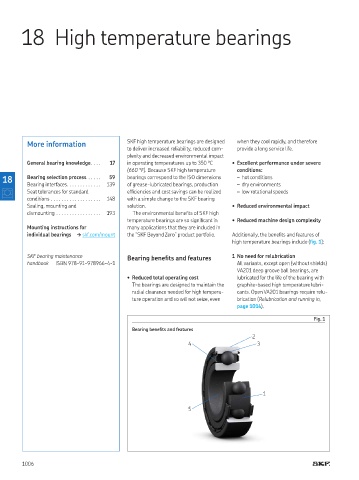
          bearing care                                 mount  the “SKF Beyond Zero” product portfolio    Additionally, the beneits and features of
          Mounting instructions for                                           high temperature bearings include (ig. 1):
          individual bearings   † skf com/mount
          SKF bearing maintenance  bearing maintenance
          SKF                              Bearing beneits and features       1 No need for relubrication
          handbook  (ISBN 978-91-978966-4-1)   ISBN 978-91-978966-4-1
          handbook                                                              All variants, except open (without shields)
                                                                                VA201 deep groove ball bearings, are
                                           • Reduced total operating cost       lubricated for the life of the bearing with
                                             The bearings are designed to maintain the   graphite-based high temperature lubri-
                                             radial clearance needed for high tempera-  cants  Open VA201 bearings require relu-
                                             ture operation and so will not seize, even   brication (Relubrication and running in,
                                                                                page 1014)
                                                                                                         Fig. 1
                                             Bearing beneits and features
                                                                                     2
                                                               4                      3


                                                                                        1

                                                               5


        1006

