


Page 544 - SKF-bearing-housings
P. 544
Flanged housings FNL series

             Load carrying capacity                                          Table 3
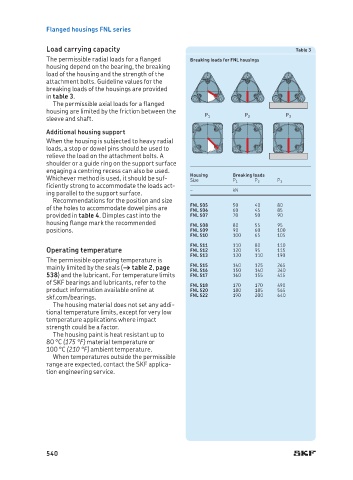
             The permissible radial loads for a flanged   Breaking loads for FNL housings
             housing depend on the bearing, the breaking
             load of the housing and the strength of the
             attachment bolts. Guideline values for the
             breaking loads of the housings are provided
             in table 3.
               The permissible axial loads for a flanged
             housing are limited by the friction between the
             sleeve and shaft.                        P 1       P 2        P 3
             Additional housing support
             When the housing is subjected to heavy radial
             loads, a stop or dowel pins should be used to
             relieve the load on the attachment bolts. A
             shoulder or a guide ring on the support surface
             engaging a centring recess can also be used.   Housing  Breaking loads
             Whichever method is used, it should be suf-  Size  P 1  P 2  P 3
             ficiently strong to accommodate the loads act-  –   kN
             ing parallel to the support surface.
               Recommendations for the position and size
             of the holes to accommodate dowel pins are   FNL 505  50  40  80
                                                                   45
                                                                         85
                                                  FNL 506
                                                             60
             provided in table 4. Dimples cast into the   FNL 507  70  50  90
             housing flange mark the recommended   FNL 508   80    55    95
             positions.                           FNL 509    90    60    100
                                                  FNL 510    100   65    105
                                                  FNL 511    110   80    110
             Operating temperature                FNL 512    120   95    115
                                                  FNL 513    130   110   190
             The permissible operating temperature is
             mainly limited by the seals († table 2, page   FNL 515  140  125  265
                                                                   140
                                                                         340
                                                  FNL 516
                                                             150
             538) and the lubricant. For temperature limits   FNL 517  160  155  415
             of SKF bearings and lubricants, refer to the   FNL 518  170  170  490
             product information available online at   FNL 520  180  185  565
             skf.com/bearings.                    FNL 522    190   200   640
               The housing material does not set any addi-
             tional temperature limits, except for very low
             temperature applications where impact
             strength could be a factor.
               The housing paint is heat resistant up to
             80 °C (175 °F) material temperature or
             100 °C (210 °F) ambient temperature.
               When temperatures outside the permissible
             range are expected, contact the SKF applica-
             tion engineering service.


             540

